
Where the Buddha and His Disciples Meet

Writer: Yuna Ock
Name of Building: Dabotap Pagoda and the Seokgatap Pagoda
Architect/Designer: Unknown craftsmen
Approximate date/Year: 8th century
Materials: Granite stone
Location: Bulguksa Temple, Gyeongju
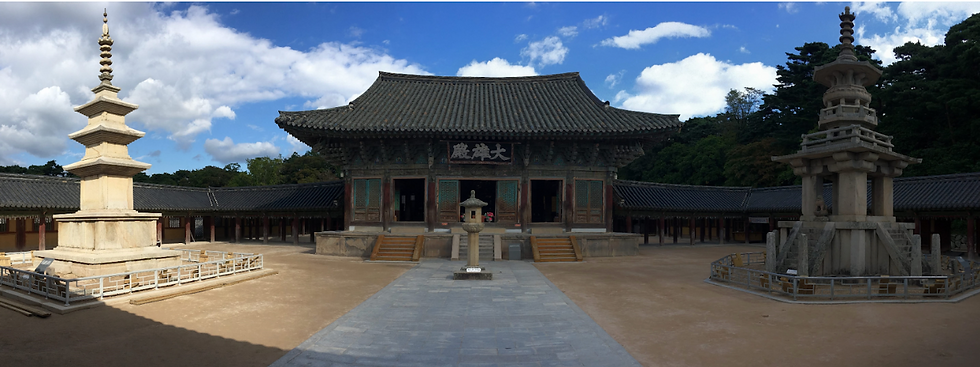
When I visited Gyeongju with my grandma 3 years ago, the two pagodas standing tall in the middle of Bulguksa Temple, standing side by side, stopped me and drew my attention. One was antique, simple, and geometric, making me feel that I stepped into the Shilla kingdom, while one looked more complex and decorative, sharing good harmony with the overall buildings around. I didn’t know much about pagodas, but the perfect symmetry and interesting chasm between the two pagodas, Dabotap and Seokgatap, caught my eye. Later, when I noticed that these stone pagodas were built more than a thousand years ago and carry different symbols and meanings, I was more impressed by their delicate details and perfect proportions.
More than 1,000 of these remain extant today; however, a lot of professionals claim that the Dabotap Pagoda and the Seokgatap Pagoda are the most unique examples because of their complex, innovative architecture and exquisite craftsmanship. The Dabotap Pagoda and the Seokgatap Pagoda also delve into profound historical meanings and symbolisms. The Seokgatap Pagoda could be interpreted as the historical Buddha, who taught the Lotus Sutra, while the Dabotap Pagoda symbolizes the disciples who listened to the Buddha and earned enlightenment. This is why they are facing each other like having a conversation —the Buddha teaching and the disciples listening, showing architectural harmony.
Unlike Chinese or Japanese pagodas that use wood and bright colors, Korean pagodas are built from plain granite, creating a calm and meditative mood while allowing them to maintain their beauty through time and even wars. They don’t try to impress with extravagance; their simple form looks shallow, but the craftsmanship of it makes it highlights their classic, ingenious design.
I chose pagodas not only because they possess beauty but also because of their peaceful feeling, since I enjoy visiting temples to relax and wish for good. Additionally, unlike flashy buildings, it is quietly beautiful. This might sound awkward, but their symmetry, balance, and even the material itself feel calm and peaceful.
References:
Korea.net
UNESCO
World History Encyclopedia


Comments